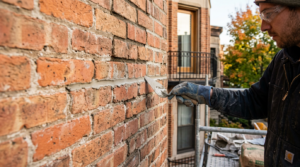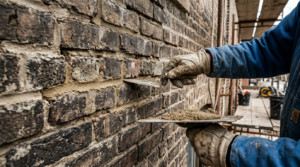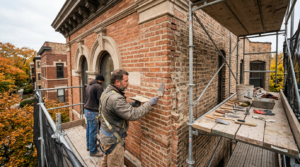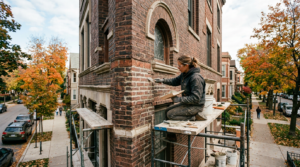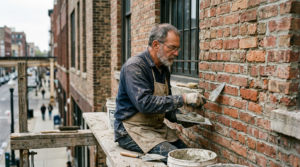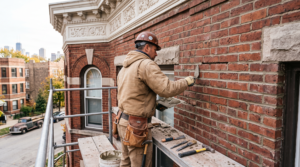
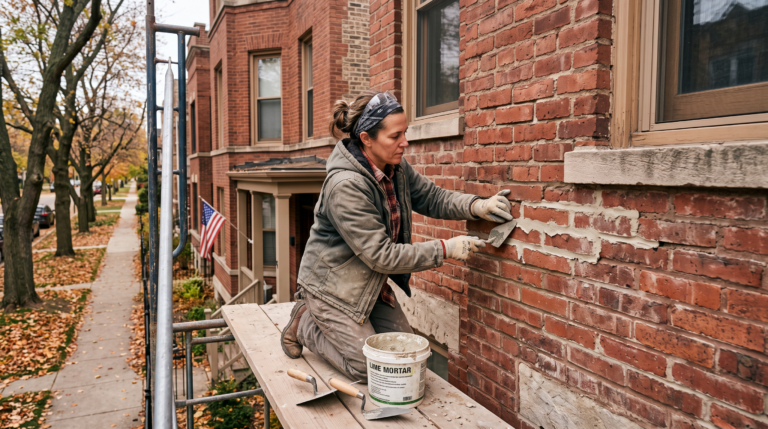
Timely tuckpointing in Chicago IL protects vintage masonry from catastrophic water penetration and winter freeze-thaw degradation. Across Chicago’s historic neighborhoods—from Lincoln Park greystones to Hyde Park and Beverly bungalows—deteriorated mortar joints allow moisture behind brick facades. When temperatures drop below freezing, trapped water expands by roughly nine percent, fracturing brick faces and destabilizing structural walls. Addressing damaged joints with chemically compatible mortar before deep winter preserves your property value and prevents costly structural rebuilding.
Key Takeaways for Property Owners
- Freeze-Thaw Defense: Chicago winters subject exterior masonry to relentless freezing and thawing cycles; deteriorating mortar joints serve as primary entry points for water.
- Mortar Compatibility: Historic structures built with soft Chicago common brick require flexible, high-calcium lime mortar to allow vapor permeability and prevent face-shell spalling.
- Preventative Economics: Investing in preventative tuckpointing saves up to 80% compared to emergency structural rebuilding, parapet reconstruction, and foundation stabilization.
Key Questions Answered:
- What is tuckpointing? Tuckpointing is the specialized masonry process of grinding out decayed, weathered mortar joints and repointing them with fresh, color-matched, flexible mortar to seal exterior building envelopes.
- Why do Chicago buildings deteriorate faster? Extreme temperature swings, lake-effect humidity, and frequent freeze-thaw cycles force trapped water to expand inside porous brickwork and rigid mortar.
The Mechanics of Chicago’s Winter Masonry Deterioration
Chicago’s distinctive architectural heritage is defined by historic common brick, limestone accents, and multi-wythe masonry walls. However, the regional climate poses severe challenges to building exteriors. Each winter, the city endures frequent oscillations between sub-freezing polar air and brief thawing spells. When precipitation penetrates open mortar joints, nighttime freezing forces the ice crystal structure to expand, placing intense hydraulic pressure on adjacent bricks.
According to regional restoration analysis from Akats Construction, water follows any open path in recessed or cracked mortar joints, rapidly compounding exterior degradation over consecutive cold snaps. If left unattended, this cycle produces irreversible brick spalling—where the hardened outer surface of the brick pops off entirely, leaving the soft interior clay exposed to rapid erosion.
Historical Evolution: The Rise of Breathable Lime Mortar Systems
Understanding the history of Chicago masonry is essential for executing lasting repairs. Following the Great Chicago Fire of 1871, municipal building codes mandated non-combustible exterior construction, initiating an unprecedented boom in solid masonry construction throughout the late 19th and early 20th centuries.
Masons of that era utilized regional Chicago common brick fired from local clay beds along the Chicago River. These bricks were relatively soft, highly porous, and designed specifically to work with traditional lime-sand mortars. Lime mortar functions as a sacrificial, breathable sponge: it absorbs moisture during driving rainstorms and releases it quickly through natural evaporation without trapping water inside the wall assembly.
When modern Portland cement gained popularity in mid-century construction, many contractors mistakenly applied rigid, impermeable cement mortars to historic buildings. Because modern cement is significantly harder and less vapor-permeable than historic common brick, seasonal thermal movement forces the brick to crack rather than allowing the mortar joint to absorb subtle building stresses.
Precision Repointing and Structural Masonry Repairs in Practice
Executing lasting masonry maintenance requires disciplined technical standards and careful adherence to historic preservation guidelines. A high-quality restoration follows four key phases:
1. Joint Raking and Dustless Preparation
Old, crumbling mortar must be removed to a uniform depth—typically 1/2 inch to 3/4 inch, or until sound mortar is reached. Skilled craftsmen use precision oscillating equipment and dust-collection systems to avoid cutting or chipping the fragile edges of historic bricks.
2. Laboratory and Visual Mortar Analysis
Restoring historic structures demands matching the original mortar’s compressive strength, aggregate profile, sand grain size, and natural pigment. Using excessively strong Type M or Type S cement on soft historic brick causes permanent shear fractures during seasonal thermal expansion.
3. Layered Packing and Joint Tooling
Fresh lime-based mortar is packed into damp joints in successive thin layers (lifts) of approximately 1/4 inch. Each layer is allowed to reach thumbprint hardness before the next is applied, ensuring solid density and eliminating internal voids where water could pool.
4. Comprehensive Stone Restoration and Lintel Care
Masonry integrity extends beyond brickwork. Embedded steel lintels over windows and doors must be inspected for rust-jacking—a condition where expanding rust forces exterior masonry upward. Applying breathable shelter coats and executing delicate Stone Restoration in Chicago IL preserves decorative limestone sills, belt courses, and decorative cornices.
| Mortar Type | Compressive Strength | Vapor Permeability | Best Use Case |
|---|---|---|---|
| Type K (Lime-Rich) | Very Low (~75 psi) | High (Maximum Breathability) | Historic pre-1900 landmark facades & soft limestone |
| Type O (Hydrated Lime) | Low (~350 psi) | High | Vintage Chicago common brick residential buildings |
| Type N (General Purpose) | Medium (~750 psi) | Moderate | Mid-century & modern exterior above-grade walls |
| Type S / M (Structural) | High (1800–2500 psi) | Low (Impermeable) | Below-grade foundations & modern retaining walls |
Tailored Solutions for Chicago Architectural Styles
Masonry maintenance is not one-size-fits-all. Every historic building type across Chicagoland requires a specialized assessment based on specific property variables:
- Chicago Two-Flats & Three-Flats: These multi-family buildings often feature expansive side common brick walls exposed to driving winds. Parapet wall caps and chimney flashing must be sealed before frost heaves displace the top masonry courses.
- Historic Greystones: Bedford limestone facades require gentle non-acidic micro-abrasive cleaning and flexible lime-based mortar to protect delicate butter joints and hand-carved stone relief.
- Classic Chicago Bungalows: Distinctive patterned brickwork and overhanging eaves require exact color matching and targeted chimney rebuilds to maintain original streetscape appeal.
- Commercial & Institutional Facilities: Multi-story brick parapets and load-bearing walls necessitate engineering-led condition reports to ensure compliance with municipal facade inspection ordinances.
Why Choose Heritage Masonry for Your Chicago Property
Heritage Masonry brings engineering precision and preservation expertise to residential, commercial, and landmark structures throughout Chicago. Rather than applying generic patches, our team follows the Secretary of the Interior’s Standards for Historic Preservation, ensuring every repair matches the compressive strength and thermal expansion characteristics of your original structure.
From historic butter joint repointing in Lincoln Park to structural parapet rebuilding in North Center and chimney reconstruction in Pullman, we provide comprehensive Structural Masonry Repairs in Chicago IL that protect your architectural investment for generations.
Frequently Asked Questions
How often does a brick building in Chicago need tuckpointing?
Most brick buildings require professional tuckpointing every 20 to 30 years. However, high-exposure architectural elements such as chimneys, parapet walls, and windward-facing elevations may require maintenance every 10 to 15 years due to direct weather exposure.
Can tuckpointing be done during the winter months in Chicago?
Standard masonry mortars require temperatures above 40°F to cure properly without freezing. While emergency cold-weather repairs can be performed using heated enclosures and insulated blankets, late spring through late autumn provides the ideal climate for durable mortar curing.
What happens if I delay tuckpointing my brick building?
Delaying repairs allows moisture to seep behind exterior walls, causing internal plaster rot, mold growth, rusted structural steel lintels, and brick face spalling. Unaddressed deterioration eventually requires full structural rebuilding at significantly higher cost.
Conclusion
Protecting your property against harsh Midwestern winters starts with maintaining a sound, weather-tight exterior envelope. Timely tuckpointing in Chicago IL prevents water infiltration, preserves architectural character, and maintains long-term structural safety. Connect with Heritage Masonry today to schedule an expert engineering-led condition assessment and safeguard your historic brickwork before winter arrives.