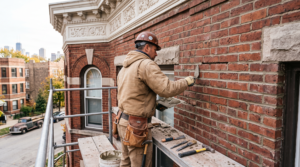
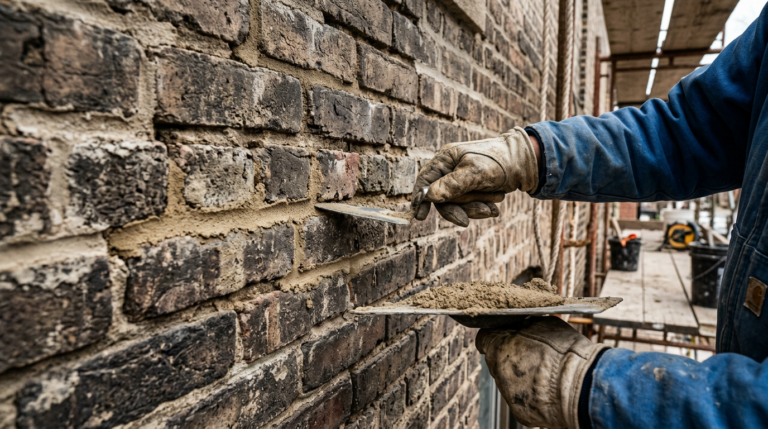
Executive Summary: Historic brick structures throughout Chicago require specialized tuckpointing techniques designed specifically for soft common brick and vintage lime mortars. When temperatures drop below freezing, trapped moisture expands within rigid mortar joints, shearing brick faces and causing costly spalling. Proper seasonal restoration requires period-accurate lime mortar formulations that match historic compression strength and protect architectural integrity.
Key Questions Answered
- What causes brick spalling during Chicago winters? Water enters porous brick and mortar joints, expands by 9% when freezing, and pops the brick face off if the surrounding mortar is too hard to allow vapor escape.
- Why is modern Portland cement harmful to historic Chicago brick? Portland cement cures significantly harder than 19th-century Chicago common brick, trapping moisture inside the softer clay units and causing accelerated structural decay.
- How often should historic parapet walls and chimneys be inspected? Because parapets and chimneys experience three-sided weather exposure without interior heat, they require comprehensive condition reviews every 3 to 5 years.
Key Takeaways (TL;DR)
- Chicago masonry undergoes dozens of freeze-thaw cycles each winter, making moisture management the defining factor in building longevity.
- Historic preservation requires sacrificial lime mortar that matches original compressive strength and thermal flexibility.
- Preventative tuckpointing and masonry condition assessments completed before deep winter prevent catastrophic spring repairs.
The Science of Chicago Freeze-Thaw Cycles and Historic Brick Deterioration
Chicago properties endure some of the most aggressive climate demands in North America. Between late autumn and early spring, temperatures regularly oscillate across the 32°F threshold. During a single winter, local buildings experience dozens of complete freeze-thaw transitions. When liquid water penetrates exterior masonry, it expands by approximately nine percent upon freezing. In properly built historic assemblies, this hydraulic pressure vents safely through breathable joint networks.
The trouble begins when maintenance practices overlook the physics of historic building envelopes. Early Chicago builders used locally fired clay units, colloquially known as Chicago common brick. These bricks are soft, highly porous, and designed to breathe naturally. When moisture enters the wall assembly during driving rain or wet snowfall, it must be permitted to evaporate back into the atmosphere. If water remains trapped behind an impermeable boundary when temperatures plunge, ice crystals form inside the microscopic pores of the clay. The resulting internal expansion fractures the outer fire-skin of the brick, leading directly to spalling, crumbling, and structural instability.
The Rise of Chicago Common Brick and Traditional Lime Mortar Systems
Following the Great Chicago Fire of 1871, municipal building codes mandated non-combustible exterior construction, sparking an unprecedented brick construction boom across neighborhoods from Lincoln Park to Hyde Park and Beverly. Manufacturers harvested glacial clay deposits from the Chicago River basin, firing them in clamp kilns to produce millions of porous common bricks and ornate architectural elements.
Masons of that era paired these clay units with lime-and-sand mortar formulations. Unlike modern synthetic compounds, traditional lime mortar serves a deliberate sacrificial function in the wall system. It remains softer and more vapor-permeable than the surrounding brick units. When structural settling or thermal movement occurs, microscopic stress fractures develop within the mortar rather than splitting the brick units themselves. When joint maintenance becomes necessary, repointing replaces the sacrificial joint while leaving the irreplaceable historic brickwork completely intact.
Adherence to the historic masonry repointing guidelines ensures that historic properties retain their structural integrity rather than suffering damage from improper materials.
Core Practice in Practice: Precision Tuckpointing and Period-Correct Mortar Matching
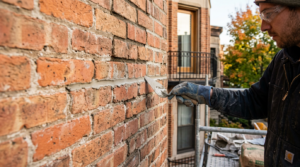
Executing high-level tuckpointing in Chicago IL requires technical precision, laboratory discipline, and deep respect for original materials. Standard commercial tuckpointing contractors frequently grind out joints using aggressive diamond blades and fill the cavities with generic Type S or Type M Portland cement. On a historic building, this practice proves disastrous.
| Mortar Characteristic | Historic Lime Mortar | Modern Portland Cement (Type S/M) |
|---|---|---|
| Compressive Strength | Low to moderate (350–750 PSI), softer than vintage brick | Extremely high (1800–2500+ PSI), harder than vintage brick |
| Vapor Permeability | High breathability; releases trapped moisture quickly | Low breathability; locks water inside adjacent bricks |
| Thermal Flexibility | Elastic; accommodates building movement and temperature shifts | Rigid; transfers mechanical stress directly into brick edges |
| Role in Assembly | Sacrificial layer designed to protect masonry units | Indestructible binder that forces bricks to fracture first |
When selecting materials for vintage residential and commercial properties, specialists follow ASTM C1324 mortar analysis standards to evaluate the exact binder-to-sand ratio, aggregate gradation, and original color pigment. The restoration process follows four distinct phases:
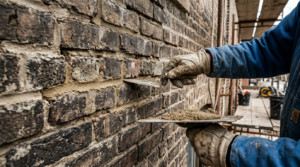
- Precision Joint Preparation: Old, failing mortar is extracted to a uniform depth of at least two times the joint width using specialized low-impact tools that prevent chipping the fragile brick edges.
- Substrate Hydration: The exposed cavity is cleaned of debris and dampened with clean water to prevent dry historic bricks from pulling moisture out of the fresh repair mix too quickly.
- Layered Application: The custom-blended lime mortar is packed in successive thin lifts (approximately 1/4-inch deep) and allowed to reach initial set before the next lift is placed.
- Historic Joint Tooling: Joints are finished with historically authentic profiles, such as concave, weathered, flush, or tight butter joints, matching the building’s original architectural design.
Diagnosing Structural Masonry Repairs in Chicago IL: Parapets, Chimneys, and Lintels
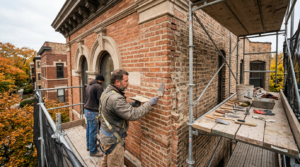
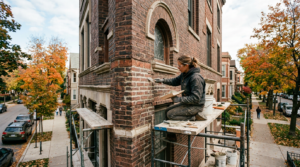
While facade repointing preserves street-facing beauty, rooftop masonry structures bear the heaviest weather burden. Parapet walls and chimneys project above the roofline where wind, driving rain, and lake-effect snow attack the masonry from three exposed sides simultaneously. Because these zones lack interior heating to drive out dampness, saturation levels remain elevated throughout the cold season.
Neglected parapet mortar allows water to seep behind exterior brick courses, rusting internal structural steel lintels and anchor ties. As embedded steel corrodes, it undergoes iron oxide expansion, swelling up to ten times its original volume. This mechanical force displaces heavy stone coping, creates stepped cracks along upper brick courses, and introduces severe structural masonry repair hazards that can trigger municipal building violations.
Homeowners and property managers should inspect for warning signs each autumn:
- Efflorescence: White, powdery salt deposits blossoming across brick surfaces, signaling active internal water migration.
- Hollow or Spalling Bricks: Loose brick faces that flake off when tapped lightly or show visible surface pitting.
- Hairline Joint Separation: Gaps between the mortar bed and the brick unit that allow driving rain to penetrate the wall cavity.
- Displaced Coping Stones: Uneven or unsealed parapet caps allowing direct roof-level water entry.
Tailored Solutions: Masonry Restoration Strategies Across Chicago Neighborhoods
Every historic property presents distinct architectural characteristics based on its construction era and neighborhood context:
- Chicago Bungalows (Beverly, Portage Park, Berwyn): Characterized by decorative face brick, raked mortar joints, and integrated front porches. Restoration requires precise color blending to match multi-toned autumnal bricks and prevent porch pier settlement.
- Victorian Greystones and Brownstones (Lincoln Park, Lakeview, Logan Square): Feature dense Bedford limestone or Lake Superior brownstone facades backed by common brick. Restoration demands specialized stone restoration in Chicago IL, non-destructive biological cleaning, and flexible lime bedding.
- Pre-War Courtyard Buildings (Hyde Park, Rogers Park, Ravenswood): Large multi-family assets with complex parapet networks, decorative terracotta banding, and multiple chimney flues requiring systematic condition assessments and multi-stage repointing.
- Historic Landmark Structures (Pullman, Gold Coast): Subject to local landmark commissions and national preservation standards. All repointing must comply strictly with documented preservation guidelines and period-accurate tool finishes.
Why Choose Heritage Masonry for Historic Restoration in Chicago
Preserving landmark institutions and vintage private residences requires technical expertise rooted in building science. Heritage Masonry approaches every restoration project through engineering-led solutions rather than standard cosmetic fixes.
Our craftsmen work in full alignment with the Secretary of the Interior’s Standards for Preservation. We carefully evaluate original compression strength, moisture transmission rates, and thermal expansion dynamics before formulating custom lime mortar mixes. Whether executing delicate butter joint repointing on an 1890s Victorian facade, rebuilding a deteriorated historic chimney in Pullman, or stabilizing structural parapets in North Center, Heritage Masonry delivers lasting protection that honors your building’s architectural legacy.
Frequently Asked Questions
Can tuckpointing be completed during winter in Chicago?
Traditional lime mortar requires ambient temperatures above 40°F to cure properly without freezing. While emergency structural stabilization can occur using heated enclosures and insulated tarps, comprehensive tuckpointing in Chicago IL is ideally completed during late spring, summer, or autumn before sub-freezing weather arrives.
What is the difference between tuckpointing and repointing?
Repointing is the structural process of cutting out decayed mortar and replacing it with fresh, compatible mortar. Tuckpointing historically refers to a decorative refinement where a contrasting narrow line of mortar is applied over the base joint to give the illusion of ultra-fine, uniform masonry joints. Today, the terms are often used interchangeably in the Midwest.
Why do bricks spall after improper repointing?
When modern hard cement is applied over historic soft bricks, moisture becomes trapped inside the clay unit. During winter freezing cycles, the ice expansion cannot push past the rigid cement, exerting intense pressure that forces the front surface of the brick to pop off and crumble.
How long does quality historic lime tuckpointing last?
When properly formulated and installed by preservation specialists, a traditional lime mortar repointing project on standard vertical walls lasts 25 to 30 years or more. Highly exposed rooftop areas like parapet walls and chimneys typically require maintenance after 15 to 20 years.
Conclusion
Protecting historic brick and stone architecture across Chicago requires proactive care and material compatibility. By addressing deteriorating joints before winter moisture freezes and expands, property owners safeguard structural value and avoid severe brick replacement costs. Trust the skilled team at Heritage Masonry to evaluate your building envelope and execute precision, preservation-grade restoration that keeps your structure secure for decades to come.