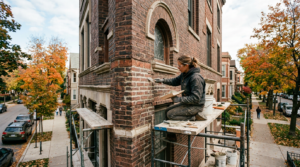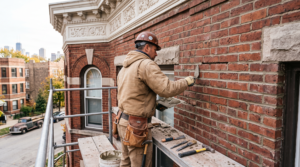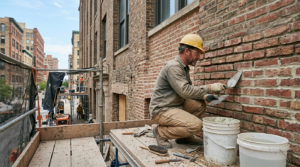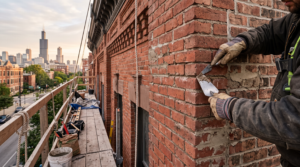
Historic brick and greystone buildings across Chicago face severe environmental strain every winter. For property owners seeking dependable tuckpointing in Chicago IL, completing proactive mortar maintenance before freezing temperatures arrive is the most effective way to prevent spalling brickwork, moisture penetration, and interior wall degradation.
Key Takeaways for Chicago Property Owners
- Freeze-Thaw Defense: Chicago’s damp lakefront climate forces trapped moisture inside failing mortar joints to expand rapidly, popping brick faces and loosening stones.
- Chemical Compatibility: Historic 19th and early 20th-century Chicago structures require soft, vapor-permeable lime mortars rather than hard Portland cement to prevent masonry fractures.
- Comprehensive Envelope Care: Successful tuckpointing must be paired with condition assessments for window lintels, parapets, and limestone coping.
The Mechanics of Midwest Freeze-Thaw Weathering
Chicago weather places extreme physical demands on building envelopes. Lake Michigan generates intense moisture and wind-driven rain throughout the autumn months. When temperature swings drop below 32°F, water trapped inside porous masonry joints expands by approximately 9% in volume. This hydraulic pressure creates stress fractures across mortar lines and forces the outer clay surface of bricks to shear off, a condition known as spalling.
According to research documented in historic masonry durability studies, moisture transport and pore-structure compatibility dictate whether an exterior wall can endure cyclic freezing. If mortar joints have eroded past 1/4 inch deep, surface water enters the wall core instead of shedding naturally down the facade.
| Warning Sign | Underlying Issue | Required Action |
|---|---|---|
| Powdering or Recessed Mortar | Binder washout and natural aging past lifespan | Precision raking and historic lime repointing |
| Spalling Brick Faces | Trapped water freezing behind hard surface patches | Brick replacement with reclaimed Chicago common brick |
| Diagonal Step Cracks | Foundation settlement or lintel deflection | Comprehensive structural masonry repairs |
| White Efflorescence Staining | Persistent water migration dissolving internal salts | Envelope leak detection and breathable cleaning |
Historic Repointing in Practice: Why Mortar Composition Matters
A common error in vintage Chicago masonry is applying modern Type S or Type M Portland cement to historic common brick or Bedford limestone. Modern Portland mortar cures into an extremely rigid, impermeable block. Because historic Chicago common brick is softer and more porous, the building envelope relies on the mortar joints to act as breathable expansion joints.
When an impermeable modern mortar is applied, the brickwork is unable to breathe or flex with thermal changes. Trapped moisture is forced directly into the brick bodies, causing the historic brick to crack and crumble. Authentic restoration follows the Secretary of the Interior’s Standards for Preservation, matching the aggregate grain, color profile, and compressive strength of original 19th-century lime binders.
Key Restoration Procedures
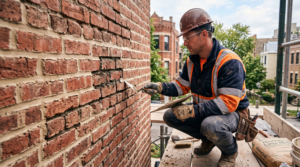
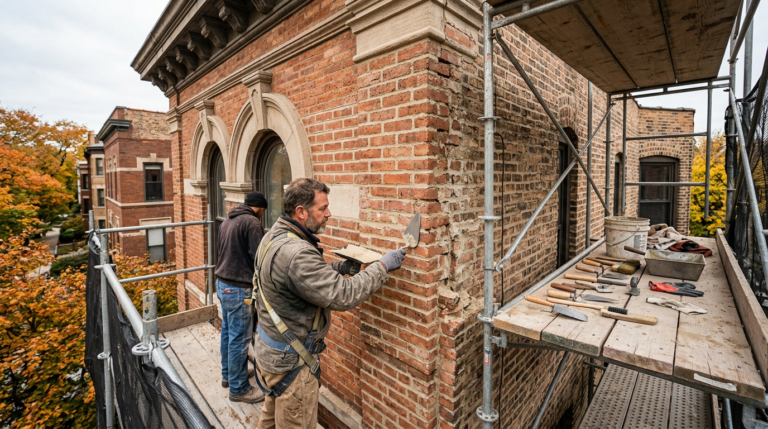
- Dust-Controlled Mortar Raking: Old, degraded mortar is cut back to a uniform depth of 1/2 to 3/4 inch using specialized diamond blade saws and hand chisels without nicking delicate brick arris edges.
- Joint Moistening and Compaction: The cleaned cavity is rinsed and dampened to prevent the dry host wall from absorbing water out of the fresh mix. Mortar is packed in successive 1/4-inch lifts.
- Period Tooling: Joint profiles are struck to match historical styles—such as concave, weathered, or flush butter joints—ensuring proper water shedding across the facade.
Tailored Solutions for Chicago Architectural Styles
Masonry requirements vary significantly depending on the age and construction style of the property:
- Lincoln Park & Lakeview Greystones: Require specialized stone restoration in Chicago IL to address porous Bedford limestone trim, decorative lintels, and intricate cornices.
- Hyde Park & Logan Square Vintage Walk-Ups: Need careful butter joint repointing and parapet wall stabilization using reclaimed common brick.
- Beverly & Norwood Park Brick Bungalows: Demand exact color matching and aggregate formulation to preserve distinctive face brick patterns and front porch piers.
Why Choose Heritage Masonry for Your Chicago Property
Heritage Masonry delivers engineering-led solutions designed specifically for Chicago’s historic residential, commercial, and institutional structures. Every restoration project begins with an in-depth technical assessment rather than superficial guesswork.
By matching original compressive strength and thermal expansion characteristics, Heritage Masonry ensures that new repairs move in harmony with the historic building fabric. From delicate butter joint repointing in Lincoln Park to full parapet wall reconstructions in North Center, their master craftsmen follow strict preservation standards to protect your architectural investment for generations.
Frequently Asked Questions
How often does a Chicago brick building need tuckpointing?
Most brick structures require tuckpointing every 20 to 30 years. High-exposure elements such as chimneys, parapet walls, and lake-facing facades often show joint decay within 15 years due to severe wind-driven rain and snow accumulation.
What is the difference between tuckpointing and repointing?
Repointing involves grinding out defective mortar and filling the joint with fresh, compatible mortar. Tuckpointing is a specialized finish technique where a contrasting, fine line of mortar is applied down the center of the joint to give historic brickwork crisp, razor-sharp visual lines.
Can tuckpointing be done during the winter in Chicago?
Quality masonry work requires consistent curing temperatures above 40°F. While heated enclosures can facilitate winter repairs, early fall is the ideal window to seal building joints before freezing weather arrives.
Why are my bricks spalling after a recent repair?
Spalling often occurs when an inexperienced contractor uses hard Portland cement on soft vintage bricks. The rigid mortar traps water and prevents thermal movement, transferring destructive freeze-thaw forces into the brick body.
Protect Your Building Envelope This Season
Safeguarding your property against harsh Midwest winter weather requires proactive maintenance and technical precision. Heritage Masonry combines deep historical expertise with rigorous structural standards to deliver lasting repairs across Chicagoland. Schedule your comprehensive masonry assessment today to keep your historic facade sound, beautiful, and weather-tight.