Preserving Historic Chicago Masonry Through Seasonal Transitions
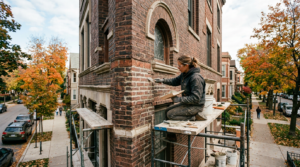
Historic brick buildings across Chicago face an aggressive climate challenge every winter. When autumn temperatures dip, trapped moisture inside porous exterior walls expands by nearly nine percent upon freezing. Without sound, flexible mortar joints, this continuous expansion fractures structural brick units, triggering costly spalling and interior moisture damage. Timely tuckpointing in Chicago using period-compatible lime mortar provides a breathable, sacrificial barrier that protects vintage masonry from catastrophic freeze-thaw breakdown.
Key Questions Answered:
- What is historic tuckpointing in Chicago? It is the precision removal of failing mortar and replacement with period-accurate lime mortar formulated to match the compression strength and thermal expansion of original vintage masonry.
- Why is autumn critical for masonry maintenance? Autumn offers the ideal temperature window (above 40°F) for lime mortar hydration before winter freeze-thaw cycles cause trapped water to crack unsealed joints.
- Why can modern Portland cement damage pre-1940 Chicago brick? Hard Portland mortar lacks vapor permeability and flexural yield, forcing thermal stress directly into soft Chicago common brick, causing permanent face shearing (spalling).
📌 Key Takeaways (TL;DR)
- Chicago’s Climate Demands Breathability: Chicago averages more than 50 freeze-thaw cycles each winter. Mortar must remain vapor-permeable so moisture escapes before it freezes.
- Softer Mortar Protects Softer Brick: Pre-1940 structures built with local clay common brick require low-compressive-strength lime mortar (Type O or custom historic blends), never rigid Type S Portland cement.
- Early Intervention Stops Structural Decay: Repointing weathered joints in early autumn seals building envelopes against wind-driven precipitation, preserving foundation integrity and architectural value.
The Rise of Chicago Common Brick and Architectural Legacy
Following the Great Chicago Fire of 1871, municipal building ordinances mandated non-combustible exterior construction, initiating the most expansive brick-building era in American urban history. Masons constructed thousands of two-flats, three-flats, classic Chicago bungalows, and commercial courtyard buildings using indigenous “Chicago common brick.” Fired from mineral-rich clay dredged from the Chicago River and surrounding plains, these bricks feature distinctive variegated tones ranging from buff salmon to deep terracotta.
Because early kilns operated at lower temperatures than modern automated kilns, vintage common bricks possess high porosity and moderate compressive strength. Builders of the late 19th and early 20th centuries paired these softer bricks with traditional high-calcium lime and coarse sand mortars. This dynamic pairing allowed entire building envelopes to breathe, absorbing ambient humidity during wet spells and expelling vapor naturally during dry afternoons.
Preserving this architectural legacy across historic neighborhoods like Lincoln Park, Hyde Park, Beverly, and Pullman requires honoring that original material chemistry. When historic buildings are treated with inappropriate modern materials, the delicate equilibrium that has protected them for over a century is instantly compromised.
Why Modern Portland Cement Destroys Historic Brickwork
A frequent error made by inexperienced contractors is applying off-the-shelf Type S or Type M Portland cement to vintage masonry. Modern commercial Portland mortars cure to compressive strengths exceeding 1,800 to 2,500 pounds per square inch (PSI). In contrast, historic Chicago common brick frequently rates below 800 to 1,000 PSI.
Masonry engineering principles dictate that mortar must always act as the sacrificial component in any wall assembly. Mortar should flex under thermal movement and erode slowly over decades, leaving the irreplaceable brick intact. When an unyielding Portland mortar is packed into a historic joint, thermal expansion and freeze-thaw cycles generate immense internal shear forces.
Because the modern mortar cannot compress or breathe, trapped moisture accumulates behind the hard joint. When winter frost sets in, the expanding ice cannot escape outward. Instead, it fractures the face of the brick right off the wall—a severe failure known as spalling. Replacing spalled historic brick is drastically more disruptive and expensive than conducting proper lime mortar repointing.
Chicago’s Freeze-Thaw Dynamic: The Science of Winter Damage
Weather data shows that the Chicago metropolitan area experiences severe environmental swings, with more than 50 annual freeze-thaw cycles during typical winter seasons. Wind-driven rains from Lake Michigan saturate exterior walls, followed within hours by sub-zero Arctic fronts. This rapid temperature drop converts liquid water trapped inside mortar voids into solid ice, expanding volume by roughly 9%.
If joints exhibit hairline fractures, crumbling binder, or recessed profiles, liquid water penetrates deep into the wall’s multi-wythe interior core. Over multiple winters, this water infiltration leads to:
- Parapet and Chimney Displacement: Uncapped or poorly pointed chimneys and roof parapets suffer structural twisting as internal ice pushes masonry courses out of plumb.
- Corrosion of Structural Steel Lintels: Water traveling through failing mortar reaches embedded steel angle irons above windows and doors, forming rust scale that jacks upper brick courses upward (pack rust).
- Efflorescence and Interior Plaster Failure: Dissolved mineral salts migrate inward through saturated masonry, destroying vintage lath, plaster, and finished trim.
Engaging in proactive preventive maintenance before freezing temperatures arrive stops this destructive cycle at the surface.
Historic Lime Mortar Tuckpointing in Practice
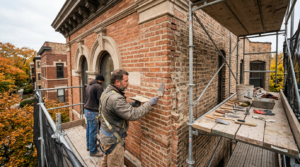
True historic restoration follows strict conservation protocols defined by the Secretary of the Interior’s Standards for Preservation. Restoring historic masonry requires an engineering-led approach encompassing four essential phases:
1. Mortar Analysis and Custom Formulation
Before mixing materials, preservation specialists evaluate the existing mortar matrix under magnification or laboratory testing. The ratio of slaked lime, hydrated lime, sharp aggregate, and natural pigments is calculated to match the original joint’s vapor permeability, elasticity, and visual texture. For pre-1930 structures, Type O mortar (rated at roughly 350 PSI) or non-hydraulic lime putty mixes ensure zero structural stress on adjacent masonry.
2. Precision Joint Raking and Dust Extraction
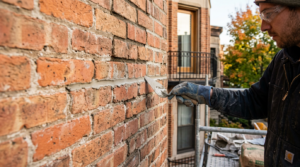
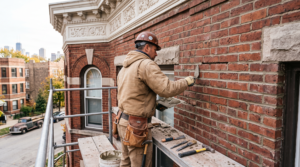
Removing deteriorated mortar must never damage fragile brick arrises (edges). Masons avoid heavy, wide abrasive wheels that score historic bricks. Instead, narrow-blade oscillating diamond tools and hand chisels gently rake the old mortar back to a uniform depth of at least 1/2 inch to 3/4 inch, creating a clean, square bedding shoulder for new material. Low-pressure water and vacuums clear all loose debris.
3. Dampening and Layered Packing (Pointing)
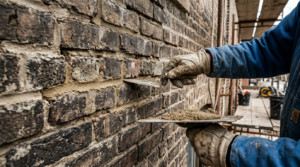
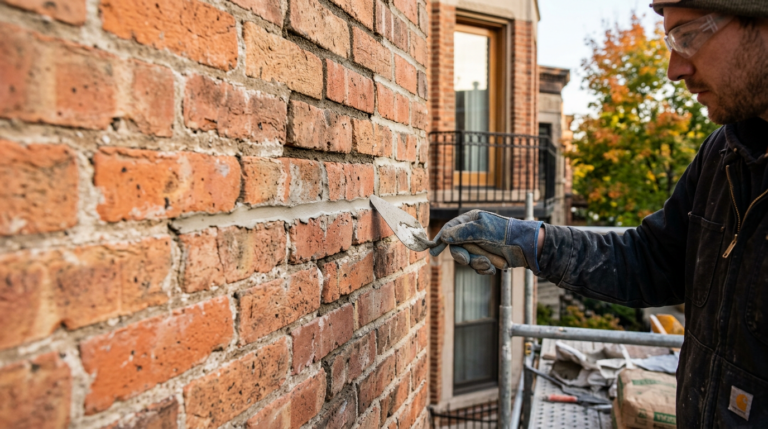
Historic common brick absorbs water rapidly. If new mortar is applied against dry brick, the brick immediately pulls moisture from the mix, preventing proper chemical cure and leaving powdery, brittle joints. Masons dampen the joint cavity with clean water before packing fresh lime mortar in consecutive 1/4-inch lifts, firmly consolidating each layer with a specialized tuckpointing jointing tool.
4. Joint Tooling and Controlled Curing
The joint face is finished to match the original architectural profile—whether a traditional concave joint, weathered joint, or historic flush bead. For fine 1890s residential facades, specialized butter joint techniques recreate paper-thin, crisp aesthetic lines. The fresh work is kept shaded and damp for several days to promote full carbonation and maximum long-term resilience.
Tailored Solutions for Chicago Architectural Styles
Every historic building typology across Chicagoland presents unique structural geometries and moisture exposures. The table below outlines preservation approaches tailored to specific property configurations:
| Building Typology | Key Vulnerability Area | Recommended Mortar Specification | Preservation Priority |
|---|---|---|---|
| Chicago Bungalow (1910–1930) | Low-pitched chimney stacks, front porch piers, and window sills | Type O or Type N Lime-Rich Blend (Custom Color Match) | Chimney recapping, facade repointing, lime wash protection |
| Victorian Two-Flat / Three-Flat | Exposed side/rear common brick walls and roof parapet copings | Traditional Non-Hydraulic Lime Mortar (Low Modulus) | Parapet rebuilding, coping stone flashing, butter joint restoration |
| Greystone / Limestone Facade | Bedford limestone ashlar joints and decorative carved pediments | High-Calcium Lime / Fine Aggregate Slurry Mix | Non-staining joint seal, biological cleaning, stone consolidation |
| Institutional & Church Masonry | Belfries, buttresses, high-altitude arches, and stone copings | Engineered Lime-Pozzolan Formulation (Moderate Strength) | Comprehensive condition assessment, structural anchorage, deep repointing |
Frequently Asked Questions About Tuckpointing in Chicago
How can I tell if my brick mortar needs repointing?
Perform a visual and physical check. If you observe gaps, hairline cracking, flaking mortar, or loose bricks, repointing is required. You can also perform a simple scratch test: gently scrape a joint with a standard screwdriver. If the mortar easily turns to fine sand or crumbles under light pressure, its binder has washed out and no longer resists water penetration.
Can tuckpointing be completed during the winter?
Lime-based mortars require sustained temperatures above 40°F (4°C) to hydrate and cure correctly. If mortar freezes before carbonation finishes, the internal bond shatters, leaving porous, failed joints. While specialized heated containment enclosures allow emergency repairs in colder months, late summer and early autumn represent the optimal window for long-lasting, cost-effective restoration.
What is the difference between tuckpointing and repointing?
In technical terms, repointing is the complete process of raking out weathered joints and packing fresh mortar flush with the masonry. Historic tuckpointing refers to a refined, decorative finishing craft where two distinct mortar colors are placed—one matching the brick to mask irregular joints and a fine, contrasting fillet strip placed down the center for a razor-sharp aesthetic.
How long should a quality lime mortar tuckpointing job last?
When properly formulated, packed, and cured by experienced preservation craftsmen, a lime mortar tuckpointing application on historic Chicago brick routinely lasts 30 to 50 years. Modern Portland patches, by comparison, often fail within 5 to 10 years while causing irreversible damage to adjacent brickwork.
Why Property Owners Trust Heritage Masonry
Preserving historic structures demands technical precision rather than generic guesswork. Heritage Masonry delivers engineering-led restoration solutions tailored to residential, commercial, and landmark properties throughout Chicago. Guided by the Secretary of the Interior’s Standards for Preservation, our team formulates custom mortar compounds that exactly match your building’s original compression strength, thermal elasticity, and aesthetic texture.
From narrow butter joint repointing in Lincoln Park and facade cleaning in Hyde Park to parapet wall stabilization in North Center and chimney reconstruction in Pullman, Heritage Masonry safeguards the architectural integrity and market value of your historic real estate.
Protect Your Historic Investment Today
Do not wait for winter freezing temperatures to exploit deteriorating mortar joints. Preparing your vintage masonry in early autumn prevents structural moisture damage and ensures your property remains protected through the harshest Chicago winters. Contact Heritage Masonry to schedule a comprehensive masonry condition evaluation and safeguard your building for decades to come.