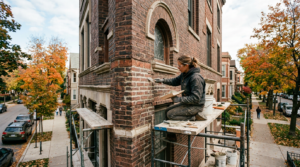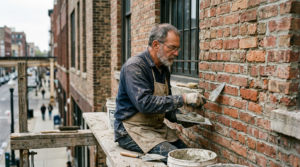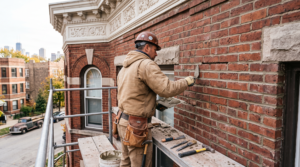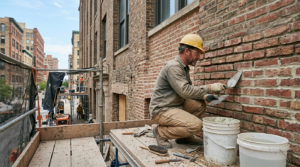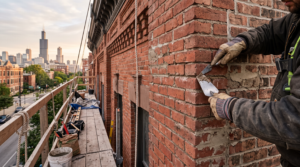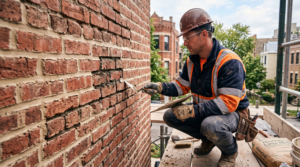
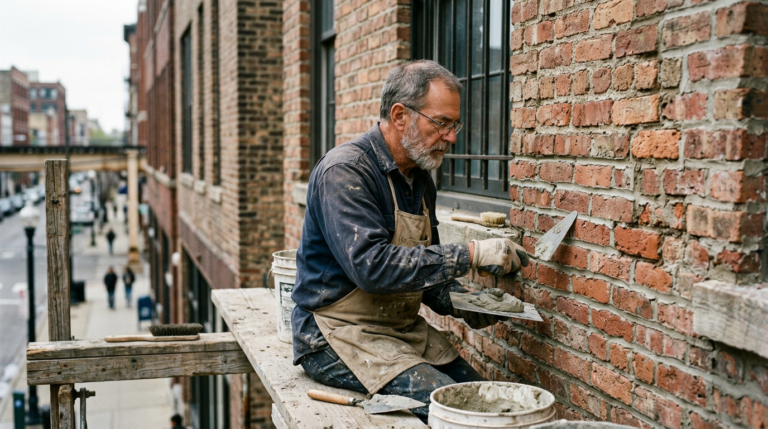
Historic brick and stone buildings define Chicago’s architectural heritage, but the city’s intense winter weather causes continuous stress on exterior masonry. When mortar joints deteriorate, water penetrates behind the brick facade, creating expensive structural hazards during sub-zero freeze-thaw cycles. Investing in timely, professional tuckpointing in Chicago IL using period-accurate lime mortar prevents spalling, eliminates moisture infiltration, and preserves the structural integrity of your building for decades.
Executive Summary: Chicago’s historic masonry requires specialized preservation rather than modern quick fixes. Standard hard Portland cement traps moisture and shatters soft vintage Chicago common brick during winter freezes. Proper restoration demands precision joint removal and custom-matched lime mortar aligned with federal preservation guidelines.
Key Takeaways (TL;DR)
- Freeze-Thaw Vulnerability: Water entering decayed mortar joints expands by 9% upon freezing, causing spalling, cracked brick faces, and inner wall damage.
- Lime Mortar Compatibility: Historic Chicago brick requires flexible, vapor-permeable lime mortar rather than modern Portland cement to avoid irreversible brick destruction.
- Preservation Standards: Proper joint raking and repointing must follow the Secretary of the Interior’s Standards for Preservation to protect structural stability and architectural value.
Key Questions Answered:
- What is tuckpointing? The skilled process of removing deteriorated mortar between masonry units to a uniform depth and replacing it with fresh, chemically compatible mortar.
- Why does Chicago common brick require lime mortar? Pre-1930s Chicago common brick is porous and soft; rigid modern cement traps trapped moisture, forcing the brick face to fracture.
- How often does a Chicago building need tuckpointing? Quality lime mortar applications typically last between 25 and 50 years depending on exposure, building orientation, and roof drainage.
Understanding Chicago Masonry and the Mechanics of Joint Deterioration
Masonry construction in the Midwest faces some of the most aggressive climate challenges in North America. Chicago experiences dozens of rapid freeze-thaw cycles each winter, where daytime melting is swiftly followed by nighttime freezing. When rain or melting snow enters porous mortar gaps, the trapped liquid freezes and expands with tremendous hydraulic force.
Mortar is engineered to act as the sacrificial component of a brick wall. It must be softer and more vapor-permeable than the surrounding masonry units so that natural moisture escapes through the joints rather than through the brick. When mortar ages, weathers, or recedes, voids form that allow moisture to pool directly against the bedding surfaces.
| Stage of Decay | Physical Symptoms | Risk Level | Recommended Action |
|---|---|---|---|
| Early Weathering | Hairline joint cracks, surface sandy wash | Moderate | Targeted maintenance repointing |
| Advanced Erosion | Mortar recessed past 1/2 inch, missing sections | High | Complete joint raking and full tuckpointing |
| Structural Compromise | Spalling brick faces, bulging walls, shifting stones | Critical | Structural masonry rebuild & brick replacement |
The Rise of Chicago Common Brick and Regional Architecture
Following the Great Chicago Fire of 1871, local building codes mandated fireproof masonry construction across the expanding city. Builders dug into the glacial clay deposits of the Chicago River and surrounding plains to manufacture hundreds of millions of distinctive Chicago common bricks. These bricks were fired in clamp kilns, producing variations in salmon, buff, and deep red tones.
Because common bricks were fired at lower temperatures than modern hard-faced engineering bricks, they possess high porosity and moderate compressive strength. 19th and early 20th-century masons paired these bricks with non-hydraulic or mildly hydraulic lime mortars. This combination allowed historic structures—from North Side greytones to South Side workers’ cottages and classic Chicago bungalows—to breathe naturally, absorbing minor moisture during storms and releasing it quickly in dry air.
Why Modern Portland Cement Destroys Vintage Brickwork
A common mistake in contemporary masonry maintenance is using off-the-shelf Type S or Type M Portland cement on historic buildings. Modern cement mixes cure into an extremely dense, rigid, and impermeable material with compressive strengths exceeding 2,500 psi, compared to historic lime mortars that average 350 to 750 psi.
The Destruction Cycle of Incompatible Mortar:
- Moisture Trapping: Rigid Portland cement forms an impermeable barrier, preventing internal moisture vapor from evaporating through the mortar joint.
- Lateral Thermal Stress: During temperature swings, historic bricks expand and contract. Because hard cement cannot flex, it exerts crushing pressure against the softer brick edges.
- Severe Spalling: When trapped moisture behind the hard cement freezes, the expansive force blows off the protective outer “fire-skin” of the brick, causing rapid crumbling and structural failure.
Studies published on building envelope performance, such as research highlighted by Building Science Corporation, confirm that altering the breathability and vapor permeability of historic masonry walls significantly accelerates freeze-thaw damage.
Precision Tuckpointing and Repointing in Practice
Executing lasting tuckpointing requires disciplined craftsmanship and technical precision. The restoration process encompasses five essential phases:
- Condition Evaluation & Mortar Analysis: Assessing the joint profile, brick integrity, and sand aggregate size to formulate a chemically compatible replacement mix.
- Surgical Joint Preparation: Removing degraded mortar to a clean depth of at least 2 to 2.5 times the joint width using specialized low-impact tools that protect fragile brick edges.
- Joint Cleaning and Pre-Wetting: Flushing dust and loose particles from the cavities and dampening the masonry to prevent the dry brick from rapidly absorbing water from the fresh mortar.
- Layered Mortar Application: Packing the lime mortar firmly into the joints in successive 1/4-inch lifts, allowing each layer to reach thumbprint hardness before applying the next.
- Period-Accurate Tooling: Finishing the joint profile (such as concave, weathered, or classic raised butter joints) to match the building’s historical design and direct water away from the wall.
Integrating Structural Masonry Repairs in Chicago IL
When joint decay is neglected for multiple seasons, water infiltration often damages internal structural elements. Parapet walls, chimneys, and window lintels are particularly susceptible to severe deterioration.
Critical Structural Interventions:
- Parapet Wall Rebuilding: Rooftop parapets endure weather from both sides. We rebuild bowing parapets using salvaged Chicago common brick and install proper coping stones.
- Corroded Lintel Restoration: Rusted steel angle irons above windows expand up to ten times their original thickness (rust jacking), cracking corner masonry. We replace corroded lintels and install correct flashing membranes.
- Chimney Reconstruction: Deteriorated chimney stacks exposed to flue gases and driving rain receive complete tear-downs, rebuilt with period-correct brick and cast concrete weather crowns.
Historic Limestone and Stone Restoration in Chicago IL
Chicago’s iconic residential architecture frequently incorporates Bedford limestone accents, rusticated stone bases, and intricately carved sandstone entryways. Restoring these natural stone elements requires distinct techniques separate from standard brick repair:
- Thermal Low-Pressure Cleaning: Removing decades of urban atmospheric soot and biological growth without damaging delicate stone mineral surfaces.
- Stone Patching & Dutchman Repairs: Repairing cracked or spalled limestone using breathable mineral repair mortars or inserting carefully matched natural stone dutchman inlays.
- Consolidation Treatments: Applying deep-penetrating mineral consolidants to stabilize sugaring sandstone and crumbling decorative elements at a molecular level.
Tailored Solutions for Chicagoland Property Owners
Masonry preservation must be customized to your specific architectural style, property usage, and neighborhood characteristics. Consider these core variables when planning your restoration project:
- Building Type & Era: 1880s Victorians, 1910s Greystones, and 1920s Chicago Bungalows each feature unique mortar formulations and joint tooling styles.
- Exposure & Microclimate: Lakefront properties along Lake Michigan face higher moisture saturation and wind-driven rain compared to inland neighborhoods like Norwood Park, North Center, or Beverly.
- Historical Landmark Regulations: Properties in designated Chicago Landmark districts must adhere strictly to local preservation ordinances and historic commission reviews.
- Scope & Phased Budgets: Prioritizing urgent weather-exposed elevations (chimneys, parapets, north/west facades) before completing cosmetic courtyard repointing.
Why Choose Heritage Masonry
Heritage Masonry brings engineering-led precision and dedicated preservation expertise to every residential, commercial, and landmark property in the Chicago region. Our approach is founded on technical accuracy rather than quick-fix guesswork.
We match the compression strength, sand gradation, and thermal expansion of your building’s original materials. By combining traditional masonry hand skills with precision tooling, our team guarantees that every repair moves in harmony with your structure, preventing future cracking and costly water intrusion.
Frequently Asked Questions
What is the difference between tuckpointing and repointing?
Repointing refers to removing damaged mortar and placing fresh mortar into the joint. Tuckpointing is a specialized decorative and functional technique where a base mortar matching the brick color is applied first, followed by a contrasting, ultra-fine fillet line centered down the joint for a crisp aesthetic finish.
Can tuckpointing be done during Chicago winters?
Lime-based and masonry mortars require temperatures consistently above 40 degrees Fahrenheit to cure properly. While emergency structural repairs can be executed using heated enclosures and insulated blankets, comprehensive tuckpointing is best scheduled from early spring through late autumn.
How do I know if my brick wall needs tuckpointing?
Warning signs include crumbling or powdery mortar, visible gaps deeper than 1/4 inch, hairline cracks along the joint line, white powdery efflorescence stains, and interior water leaks on plaster or drywall adjacent to exterior masonry.
Why is power washing dangerous for historic Chicago brick?
High-pressure power washing strips away the protective outer surface (fire-skin) of historic brick, leaving the soft interior core exposed to rapid water absorption and accelerated weathering. Historic brick cleaning should always rely on gentle thermal steam and non-destructive detergents.
Conclusion
Protecting your property against the harsh Chicago climate begins with proper masonry care. By choosing specialized tuckpointing, meticulous mortar matching, and comprehensive structural maintenance, you safeguard your investment and maintain architectural beauty for generations to come. Connect with the preservation craftsmen at Heritage Masonry to schedule your professional masonry condition evaluation and receive a detailed, long-term restoration plan tailored to your building.