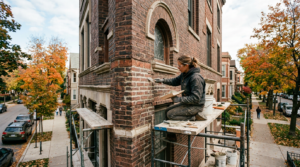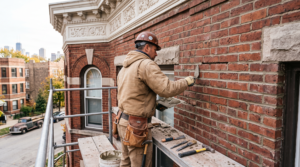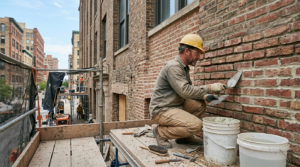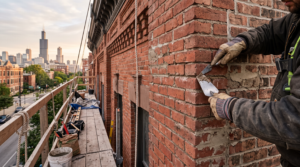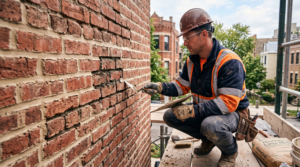
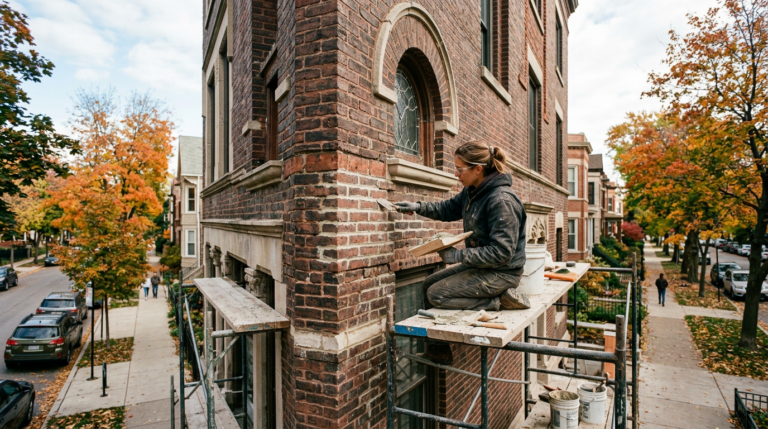
Timely tuckpointing in Chicago IL protects historic masonry structures against water penetration, mortar degradation, and severe freeze-thaw spalling before freezing winter temperatures arrive. By replacing failing joints with period-appropriate lime mortar, property owners preserve structural stability and defend original brickwork against the Midwest’s hundred-plus annual freeze-thaw cycles.
Key Takeaways (TL;DR)
- Freeze-Thaw Vulnerability: Over 100 annual freeze-thaw cycles in Chicago cause trapped moisture to expand within open joints, leading to spalling brick and structural shifting.
- Chemical Compatibility: Historic Chicago brickwork requires softer, breathable lime-based mortar rather than rigid modern Portland cement to avoid irreversible brick face fracturing.
- Seasonal Timing: Mortar requires sustained ambient temperatures above 40 degrees Fahrenheit to cure correctly, making early autumn the optimal window for exterior masonry stabilization.
Key Questions Answered
- What is historic tuckpointing? The specialized process of removing compromised mortar and packing fresh, chemically matched mortar into joints to restore weather-tight integrity.
- Why do Portland cement repairs fail on older buildings? Hard Portland mortar prevents natural vapor breathing, trapping moisture and forcing thermal expansion stresses directly into softer historic brick faces.
- When should Chicago masonry repairs be completed? Exterior mortar repointing should be executed before sustained freezing temperatures disrupt the chemical hydration process.
The Science of Freeze-Thaw Degradation on Chicago Facades
Chicago masonry operates as an active moisture management system. Older solid-masonry walls absorb precipitation during rainstorms and safely release vapor back into the atmosphere as ambient conditions dry. When mortar joints weather, recede, or crack, excess water penetrates deep into the wall assembly.
During a typical winter in the region, ambient temperatures repeatedly fluctuate across the freezing mark. Water expands by roughly 9% in volume when freezing into ice. Trapped water inside saturated mortar voids generates immense internal hydraulic pressure, fracturing joint bonds and pushing the outer surfaces off common brick and limestone accents.
The Rise of Traditional Lime Mortar in Historic Preservation
In historic construction throughout neighborhoods like Lincoln Park, Hyde Park, and Beverly, masons utilized lime-rich mortars tailored specifically to soft, locally fired clay brick and Indiana limestone. These traditional mortars remain flexible, accommodating structural settlement and seasonal thermal movement while allowing vapor to evaporate freely through the joints.
Throughout mid-century renovations, inappropriate applications of rigid Type M or Type S Portland cement became widespread. Because Portland mortar cures much harder than antique brick, natural building movements cause the brick edges to shear and crack rather than allowing the mortar joint to act as the sacrificial component. Modern preservation standards, including the Secretary of the Interior’s Standards for Preservation, dictate that all repointing formulations strictly match the compression strength and vapor permeability of original materials.
Diagnostic Assessment: Identifying Failing Joints
Identifying mortar distress before catastrophic failure saves building owners substantial structural repair expenses. Key warning signs across residential and commercial elevations include:
- Mortar Sugaring and Erosion: Gaps where mortar has receded more than a quarter-inch behind the brick face, exposing vulnerable masonry corners.
- Hairline Fissures and Stepping Cracks: Diagonal stair-step cracking along mortar lines indicating localized foundation movement or localized water entry.
- Spalling Brick Surfaces: Brick faces flaking, chipping, or popping off due to subsurface ice expansion or incompatible past mortar applications.
- Efflorescence Staining: White powdery salt deposits leaching onto facade surfaces, signaling chronic interior moisture migration.
Critical Elevation Points: Chimneys, Parapets, and Facades in Practice
Masonry elements exposed on multiple sides suffer the fastest rate of atmospheric degradation. Chimneys and parapet walls endure direct wind-driven rain and snow accumulation without benefiting from interior building heat to facilitate drying.
As documented in regional facade analyses by Chicago masonry specialists, parapet walls frequently develop deteriorated joints 10 to 15 years sooner than sheltered lower elevations. Ensuring chimney crowns are intact, flashing is secure, and masonry joints are fully repointed prevents water from infiltrating living spaces below.
Tailored Solutions for Historic Structures
Effective masonry restoration varies based on building architecture, construction era, and specific material assemblies:
- Chicago Brick Bungalows: Focus on restoring street-facing face brick, rebuilding exposed roofline chimneys, and repointing lower common-brick courses exposed to ground moisture and winter deicing salts.
- Limestone Greystones: Prioritize fine joint repointing, water table stone protection, and non-destructive surface cleaning to protect delicate carved details.
- Multi-Family Courtyard Buildings: Emphasize parapet wall reconstruction, coping stone stabilization, and structural lintel assessments above window openings.
- Historic Commercial Facades: Focus on comprehensive condition evaluations, facade ordinance compliance, and localized structural rebuilding.
Why Choose Heritage Masonry for Your Restoration Needs
Heritage Masonry delivers engineering-led restoration solutions for historic residential, commercial, and institutional structures across Chicago. Our approach relies on rigorous technical assessments rather than guesswork, matching the compressive strength, aggregate profile, and thermal expansion properties of your building’s original fabric. By adhering strictly to preservation best practices, our skilled team ensures that repairs move in harmony with your structure, preventing long-term stress fractures and preserving architectural heritage for generations to come.
Frequently Asked Questions About Masonry Repointing
How deep should old mortar be removed before repointing?
Deteriorated mortar should be carefully removed to a depth of 2 to 2.5 times the width of the joint, or until sound mortar is reached, using precision hand tools and specialized dust-controlled equipment that prevents damage to adjacent brick edges.
What is the difference between tuckpointing and repointing?
Repointing is the structural process of cutting out decayed mortar and filling the joint with fresh mortar. Tuckpointing historically involves placing contrasting colored mortar fillets inside the joints to create the visual illusion of razor-thin, perfectly uniform brickwork.
Can tuckpointing be done during cold winter months?
High-quality masonry repointing requires sustained temperatures above 40 degrees Fahrenheit for mortar to hydrate and cure to its intended strength. Exterior work in freezing temperatures without specialized heated enclosures risks premature mortar disintegration.
Conclusion
Protecting historic masonry from harsh winter conditions requires proactive inspection and chemically compatible joint restoration. Heritage Masonry provides comprehensive condition assessments and meticulous tuckpointing in Chicago IL to safeguard your property against moisture intrusion and freeze-thaw damage.